
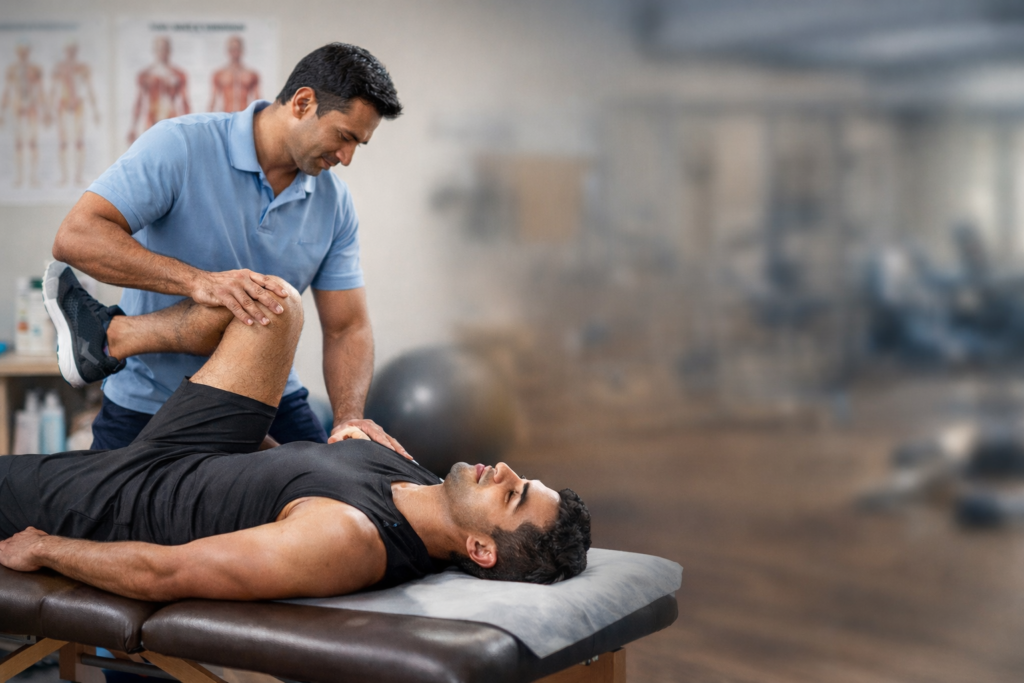
Sports injuries don’t wait for a good time. One moment you’re sprinting at the Cyber Hub running club, the next your calf has completely seized up. You roll your ankle on a Sunday football pitch in Sector 56 and spend the rest of the week hobbling. Your elbow starts aching halfway through a padel match and just doesn’t stop. What you do in those first few days—and who you turn to—matters more than most people realize.
Gurgaon’s fitness scene has grown enormously. Marathon groups, corporate cricket leagues, CrossFit boxes, padel courts along Golf Course Road. There’s a lot of physical output happening, often from people whose joints and tendons aren’t quite ready for that kind of load. Sports Physiotherapy in Gurgaon exists to bridge that gap—catching injuries early, treating them the right way, and getting you back to your sport in better shape than before.
Here’s what that actually looks like.
What Does Sports Physiotherapy in Gurgaon Actually Involve?
Sports Physiotherapy in Gurgaon isn’t the same as general physiotherapy. Standard physio focuses on restoring everyday function—managing pain, getting you walking normally again. Sports physio goes further. It rebuilds the capacity to sprint, cut, jump, and move under real athletic demand.
A typical treatment course includes:
- A full biomechanical assessment to find the root cause, not just where it hurts
- Manual therapy—joint mobilization, soft tissue release—to unlock range of motion the injury has restricted
- Progressive loading using resistance bands, kettlebells, or bodyweight exercises introduced in a deliberate order
- Movement correction for problems like overstriding during running or poor hip mechanics that quietly contributed to the injury in the first place
- A return-to-sport clearance based on measurable criteria—single-leg hop distance, grip strength ratios—not just “it feels okay”
Most clinics in DLF Phase 2, Sector 29, and South City schedule initial assessments at 45 to 60 minutes, with twice-weekly follow-ups during active rehab. That frequency isn’t arbitrary—too many gaps and tissue adaptation genuinely stalls.
How Is an Ankle Sprain Treated in Gurgaon?
Ankle sprains rank among the most common injuries treated in sports physiotherapy clinics. They happen when the foot rolls too far inward or outward, overloading the lateral ligaments—most often the ATFL. Ankle Sprain Treatment in Gurgaon follows a phased approach based on actual tissue healing, not a set number of rest days.
In the first 48 to 72 hours, most physiotherapists now follow the POLICE protocol—protection, optimal loading, ice, compression, elevation—rather than the old RICE approach. The reason: some early controlled loading has been shown to support ligament repair rather than slow it down.
As swelling clears, the focus shifts to restoring dorsiflexion through joint mobilization. Progress gets measured with a goniometer each session, so there’s an objective record of improvement rather than just how the ankle feels that day. Peroneal muscle strengthening follows, along with wobble board and single-leg balance work. A poorly coordinated ankle is around five times more likely to re-sprain in the year after the original injury, so this phase isn’t optional.
The final stage brings in sport-specific challenges: lateral bounds, 90-degree cuts, box landings. If you’ve sprained the same ankle more than once, a structured Ankle Sprain Treatment in Gurgaon program is the only reliable way to break that pattern. Skipping rehab after repeated sprains leads to chronic instability—a problem that takes far longer to fix than the original injury ever would have.
What’s the Treatment Process for Calf Strain in Gurgaon?
Calf strains tend to happen in an instant. A hard push-off during a squash rally, an explosive sprint start, a jump landing that goes slightly wrong—and the gastrocnemius or soleus tears under load. Calf Strain Treatment in Gurgaon depends on the grade of the injury, confirmed through palpation and, for Grade 2 or 3 tears, often an ultrasound.
Grade 1 strains involve minor fiber disruption and usually resolve within one to two weeks with progressive loading. Grade 2 strains—partial tears—typically need four to six weeks of supervised rehab before running at full speed is appropriate. Grade 3 strains, meaning a complete rupture, can take three months or more, and often require an orthopedic consultation before physiotherapy even starts.
Eccentric loading drives most of the recovery. Standing calf raises progress to single-leg raises, then to drop-and-catch heel raises off a step. That sequence rebuilds the calf’s ability to absorb force under stretch—the exact mechanism that failed during the original injury.
Rushing back is the single biggest reason calf strains keep recurring. A physiotherapist compares single-leg heel raise counts and calf circumference between legs to confirm genuine readiness. “It feels fine” isn’t enough information at that point.
How Are Tennis Elbow and Golfer’s Elbow Treated in Gurgaon?
Worth saying upfront: you don’t need to play tennis or golf to develop either of these conditions. Tendon overload at the elbow is just as common in someone typing for eight hours a day as it is in an athlete. Repetitive strain is repetitive strain, regardless of whether it comes from a backhand or a keyboard.
Tennis elbow (lateral epicondylitis) affects the extensor tendons on the outer elbow. Gripping a coffee cup hurts. Picking up a bag hurts. Golfer’s elbow (medial epicondylitis) sits on the inner side and typically flares with wrist flexion or any firm gripping motion.
Tennis & Golfers Elbow Treatment in Gurgaon generally works through:
- Reducing the aggravating activity temporarily—not stopping all movement, just the specific load causing the problem
- Deep tissue massage and myofascial release to settle the irritated tendon
- Eccentric strengthening with a light dumbbell or resistance band—multiple tendinopathy studies show this consistently outperforms rest as a standalone treatment
- Counterforce bracing to offload the tendon insertion during daily activity
- An ergonomic review for desk workers, covering wrist angle, keyboard height, and mouse position—these details contribute more than most people expect
Before considering a corticosteroid injection or PRP therapy, give six to eight weeks of consistent eccentric loading a proper chance. Most patients following a Tennis & Golfers Elbow Treatment in Gurgaon program see meaningful improvement well within that timeframe. Surgical referral is genuinely uncommon outside of cases where six months of conservative care hasn’t made a dent.
Getting Back to Your Sport, Stronger Than Before
Pain-free at rest and ready to compete are two very different things. An ankle that feels fine on a walk can still buckle under a sharp lateral cut at speed. Rebuilding strength, coordination, and confidence under load takes longer than most athletes want—and skipping that final phase is exactly how the same injury comes back a month later.
Your sport determines what the end stages of rehab actually look like. A footballer working on deceleration drills has different targets than a marathon runner following a graded return-to-running plan. Getting those specifics right is the difference between rehab that holds and rehab that just masks symptoms for a while.
If you’re coordinating care from Delhi or want additional guidance on injury-specific recovery, the Physiotherapist in Delhi website has detailed resources on treatment timelines and rehab approaches worth reading alongside your Gurgaon-based program.